All the filibuster option does is change the definition of a majority.Phatscotty wrote:So Mets, are you saying, on principle, you think a majority should rule, and the minority should have no voice?
Do you support any checks or balances on power?


Moderator: Community Team

All the filibuster option does is change the definition of a majority.Phatscotty wrote:So Mets, are you saying, on principle, you think a majority should rule, and the minority should have no voice?
Do you support any checks or balances on power?

okay....Metsfanmax wrote:All the filibuster option does is change the definition of a majority.Phatscotty wrote:
Do you support any checks or balances on power?
You would know the answer to that if you understood my post instead of strawmanning it.Phatscotty wrote:okay....Metsfanmax wrote:All the filibuster option does is change the definition of a majority.Phatscotty wrote:
Do you support any checks or balances on power?
and the previous definition was one with checks and balances and forced compromise, and the new definition is majority rules with no checks or balances since the minority has no say....so, that being pointed out in black and white.... are you saying, on principle, you think a majority should rule, and the minority should have no voice?
How much longer is Ginsburg gonna be able to hold out in her oxygen tent? She and Briar either gonna hafta quit now or keep working until they 100 if they don't want a 7-2 conservative court. I hope Reid at least sent her some chocolates after this. No wonder those cats so mad for stem-cell therapy.The prospects are very strong that the Democrats will lose the Senate next year and there is an excellent chance of [them] losing the White House. When Republicans come into power, they’re going to include Supreme Court nominees.
http://www.politico.com/story/2013/11/c ... z2lWSOeaTG

Pack Rat wrote:if it quacks like a duck and walk like a duck, it's still fascism
https://www.conquerclub.com/forum/viewt ... 0#p5349880
Nazi shit? How about "the only people you may appoint to carry out your executive functions are people that don't threaten our political ambitions." This chart says it all:Phatscotty wrote:I know your answer is yes. I'm only trying to help you think it through. I suppose it doesn't really matter since what's done is done. I just don't buy your argument about how it's better to transform the rules that have served us well for over 200 years than it is for Democrats to just nominate someone who is more agreeable. That's some Nazi shit.
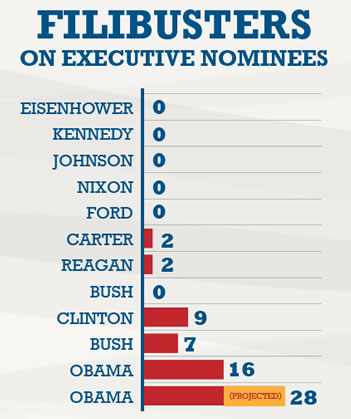


But you assume Obama's picks are good picks, don't you? We haven't even named the people we are talking about, but you are defending them anyways. What do you know about the nominees? In your mind, is there even room for a valid discussion whether these people are good people, to talk about their past, to see if they are qaulified? Doesn't any of that matter to you? Why should these people not be filibustered?Metsfanmax wrote:How about "the only people you may appoint to carry out your executive functions are people that don't threaten our political ambitions." This chart says it all:
Now either Eisenhower, Kennedy, Johnson, Nixon and Ford all managed to choose perfectly agreeable nominees where Clinton, Bush and Obama failed, or something is wrong with the Senate.
The minority party was apparently filibuster-ineligible (had fewer than 40 seats) for 14 of the 24 years of Eisenhower, Kennedy, Johnson, Nixon and Ford. In other years, the minority party was the president's own party so nominees would simply be voted down (Lewis Strauss). So, this seems like one of those charts that look snazzy in a JPG but don't really mean a whole lotMetsfanmax wrote:Nazi shit? How about "the only people you may appoint to carry out your executive functions are people that don't threaten our political ambitions." This chart says it all:Phatscotty wrote:I know your answer is yes. I'm only trying to help you think it through. I suppose it doesn't really matter since what's done is done. I just don't buy your argument about how it's better to transform the rules that have served us well for over 200 years than it is for Democrats to just nominate someone who is more agreeable. That's some Nazi shit.
Now either Eisenhower, Kennedy, Johnson, Nixon and Ford all managed to choose perfectly agreeable nominees where Clinton, Bush and Obama failed, or something is wrong with the Senate.
Pack Rat wrote:if it quacks like a duck and walk like a duck, it's still fascism
https://www.conquerclub.com/forum/viewt ... 0#p5349880
Yes, but at any time a Senator may choose to filibuster by continuing debate by speaking as long as he or she wishes. So what people called "filibustering" of nominees was almost always using the term indirectly -- it was the threat of a filibuster that was really doing the job. Any time someone attempted to end the debate and bring a vote to the floor, a person from the objecting party could simply get up and speak, which meant that effectively the vote could not occur. The way to prevent such a filibuster was with three-fifths of the Senate voting to end debate immediately -- this is why, if you have 40 people on your side, you have effectively filibustered the process even without speaking. Under the new rules, it only requires a majority of the Senate to end debate and preclude any filibuster.thegreekdog wrote:Maybe I don't understand a fillibuster, but doesn't it just lengthen the amount of time for a law to pass? In other words, if Rand Paul stops talking, doesn't the Senate just go and ratify the guy 51-49 anyway?
Now you're flip-flopping. First they had to be acceptable nominees -- now they have to be good nominees? Which is it? And does good mean good character or good at their job? The point is, unless Obama is picking nominees that are outrageous in historical context, then the problem here lies with the Senate and not the President.But you assume Obama's picks are good picks, don't you? We haven't even named the people we are talking about, but you are defending them anyways. What do you know about the nominees? In your mind, is there even room for a valid discussion whether these people are good people, to talk about their past, to see if they are qaulified? Doesn't any of that matter to you? Why should these people not be filibustered?
Having fewer than 40 seats doesn't mean you can't filibuster. It just means that if you do, the majority party can end debate with a cloture vote. If any of the nominees during those times were absurd, you can be sure someone would have filibustered on principle even if they knew that they could be shut down. So unless Obama's nominees are outrageous in historical context, then it demonstrates that current use is done only because Senators know they can do it and get away with it.The minority party was apparently filibuster-ineligible (had fewer than 40 seats) for 14 of the 24 years of Eisenhower, Kennedy, Johnson, Nixon and Ford, so this seems like one of those charts that look snazzy in a JPG but don't really mean a whole lot. [https://en.wikipedia.org/wiki/Party_divisions_of_United_States_Congresses]
I already am consistent, I publicly criticized when the Republicans threatened the same thing in 2005.thegreekdog wrote:Maybe I don't understand a fillibuster, but doesn't it just lengthen the amount of time for a law to pass? In other words, if Rand Paul stops talking, doesn't the Senate just go and ratify the guy 51-49 anyway?
By the way PS, I'm taking notes for 2016. Hopefully you remain consistent.

lol I'm not flopping at all. I already said, just like the rules said and the Constitution says and our tradition and our heritage has always been, the nominees have to be good for the people we sent to judge them as good or not according to the people we sent to Washington to judge just such things. If the American people sent Obama a supermajority, then this would be fine. But the American people took away the majority from Obama. I am repeating myself again.Metsfanmax wrote:Yes, but at any time a Senator may choose to filibuster by continuing debate by speaking as long as he or she wishes. So what people called "filibustering" of nominees was almost always using the term indirectly -- it was the threat of a filibuster that was really doing the job. Any time someone attempted to end the debate and bring a vote to the floor, a person from the objecting party could simply get up and speak, which meant that effectively the vote could not occur. The way to prevent such a filibuster was with three-fifths of the Senate voting to end debate immediately -- this is why, if you have 40 people on your side, you have effectively filibustered the process even without speaking. Under the new rules, it only requires a majority of the Senate to end debate and preclude any filibuster.thegreekdog wrote:Maybe I don't understand a fillibuster, but doesn't it just lengthen the amount of time for a law to pass? In other words, if Rand Paul stops talking, doesn't the Senate just go and ratify the guy 51-49 anyway?
Now you're flip-flopping. First they had to be acceptable nominees -- now they have to be good nominees? Which is it? And does good mean good character or good at their job? The point is, unless Obama is picking nominees that are outrageous in historical context, then the problem here lies with the Senate and not the President.But you assume Obama's picks are good picks, don't you? We haven't even named the people we are talking about, but you are defending them anyways. What do you know about the nominees? In your mind, is there even room for a valid discussion whether these people are good people, to talk about their past, to see if they are qaulified? Doesn't any of that matter to you? Why should these people not be filibustered?
This is a third unique point in this discussion. First the nominees have to be acceptable -- then they have to be good people -- now it doesn't matter whether they are acceptable or good people if there's a supermajority in the Senate.Phatscotty wrote:lol I'm not flopping at all. I already said, just like the rules said and the Constitution says and our tradition and our heritage has always been, the nominees have to be good for the people we sent to judge them as good or not according to the people we sent to Washington to judge just such things. If the American people sent Obama a supermajority, then this would be fine. But the American people took away the majority from Obama. I am repeating myself again.Metsfanmax wrote:Yes, but at any time a Senator may choose to filibuster by continuing debate by speaking as long as he or she wishes. So what people called "filibustering" of nominees was almost always using the term indirectly -- it was the threat of a filibuster that was really doing the job. Any time someone attempted to end the debate and bring a vote to the floor, a person from the objecting party could simply get up and speak, which meant that effectively the vote could not occur. The way to prevent such a filibuster was with three-fifths of the Senate voting to end debate immediately -- this is why, if you have 40 people on your side, you have effectively filibustered the process even without speaking. Under the new rules, it only requires a majority of the Senate to end debate and preclude any filibuster.thegreekdog wrote:Maybe I don't understand a fillibuster, but doesn't it just lengthen the amount of time for a law to pass? In other words, if Rand Paul stops talking, doesn't the Senate just go and ratify the guy 51-49 anyway?
Now you're flip-flopping. First they had to be acceptable nominees -- now they have to be good nominees? Which is it? And does good mean good character or good at their job? The point is, unless Obama is picking nominees that are outrageous in historical context, then the problem here lies with the Senate and not the President.But you assume Obama's picks are good picks, don't you? We haven't even named the people we are talking about, but you are defending them anyways. What do you know about the nominees? In your mind, is there even room for a valid discussion whether these people are good people, to talk about their past, to see if they are qaulified? Doesn't any of that matter to you? Why should these people not be filibustered?
Now Obama and the Democrats just changed the rules to go around the election results.
We know one of the nominees was appointed by Obama on the recommendation of Marco Rubio. After the appointment was formalized, Rubio then filibustered his own recommendation.Phatscotty wrote: But you assume Obama's picks are good picks, don't you? We haven't even named the people we are talking about, but you are defending them anyways. What do you know about the nominees?
Pack Rat wrote:if it quacks like a duck and walk like a duck, it's still fascism
https://www.conquerclub.com/forum/viewt ... 0#p5349880
I have to agree with Rubio, though, that less than two years in prison is far too lenient a sentence for killing a cyclist. But that's an issue with the weak laws protecting cyclists and making them second-class citizens on the road, and not as much with the judge's ruling in that case.saxitoxin wrote:We know one of the nominees was appointed by Obama on the recommendation of Marco Rubio. After the appointment was formalized, Rubio then filibustered his own recommendation.Phatscotty wrote: But you assume Obama's picks are good picks, don't you? We haven't even named the people we are talking about, but you are defending them anyways. What do you know about the nominees?

So somehow if a motorists kills a cyclist, then there's no way the motorist can be charged with vehicular manslaughter or plain old vanilla manslaughter?Metsfanmax wrote:I have to agree with Rubio, though, that less than two years in prison is far too lenient a sentence for killing a cyclist. But that's an issue with the weak laws protecting cyclists and making them second-class citizens on the road, and not as much with the judge's ruling in that case.saxitoxin wrote:We know one of the nominees was appointed by Obama on the recommendation of Marco Rubio. After the appointment was formalized, Rubio then filibustered his own recommendation.Phatscotty wrote: But you assume Obama's picks are good picks, don't you? We haven't even named the people we are talking about, but you are defending them anyways. What do you know about the nominees?
It cuts both ways. Grant the judge more discretion, and he's more apt to being corrupted, having his emotions affect him (instead of upholding the rule of law--which you like, right?), etc.mrswdk wrote:The US legal system could benefit from increased discretionary powers for judges. In China a judge's primary concern should be the outcome that is best for society, rather than following the very exact letter of the law even if doing so is clearly absurd (e.g. petty criminals who receive life sentences under 'three strikes' legislation).
Notice that the case in question was described as a "hit-and-run." Not manslaughter. In fact, there have been very few cases where a driver was prosecuted for killing a cyclist (except in cases of hit-and-run or DUI). It is very rare when someone who kills a cyclist with a vehicle is actually charged with even manslaughter. Now, the laws on vehicular manslaughter are there -- but the problem lies in both interpretation of the law and how juries interpret the law. Since most jurists are themselves drivers, they are likely to identify with the driver and think "it was just an accident." Consequently, prosecutors are unlikely to bring charges because of just how hard it is to convict on this charge. If the legal infrastructure for treating these as more serious crimes, more regularly were there, then cyclists would both likely not be killed as often, and be able to pursue safer cycling infrastructure.BigBallinStalin wrote:So somehow if a motorists kills a cyclist, then there's no way the motorist can be charged with vehicular manslaughter or plain old vanilla manslaughter?Metsfanmax wrote:I have to agree with Rubio, though, that less than two years in prison is far too lenient a sentence for killing a cyclist. But that's an issue with the weak laws protecting cyclists and making them second-class citizens on the road, and not as much with the judge's ruling in that case.saxitoxin wrote:We know one of the nominees was appointed by Obama on the recommendation of Marco Rubio. After the appointment was formalized, Rubio then filibustered his own recommendation.Phatscotty wrote: But you assume Obama's picks are good picks, don't you? We haven't even named the people we are talking about, but you are defending them anyways. What do you know about the nominees?
If not, then how is the underlined true?
Nah, you know what I mean but are trying to turn it into something else.Metsfanmax wrote:This is a third unique point in this discussion. First the nominees have to be acceptable -- then they have to be good people -- now it doesn't matter whether they are acceptable or good people if there's a supermajority in the Senate.Phatscotty wrote:lol I'm not flopping at all. I already said, just like the rules said and the Constitution says and our tradition and our heritage has always been, the nominees have to be good for the people we sent to judge them as good or not according to the people we sent to Washington to judge just such things. If the American people sent Obama a supermajority, then this would be fine. But the American people took away the majority from Obama. I am repeating myself again.Metsfanmax wrote:Yes, but at any time a Senator may choose to filibuster by continuing debate by speaking as long as he or she wishes. So what people called "filibustering" of nominees was almost always using the term indirectly -- it was the threat of a filibuster that was really doing the job. Any time someone attempted to end the debate and bring a vote to the floor, a person from the objecting party could simply get up and speak, which meant that effectively the vote could not occur. The way to prevent such a filibuster was with three-fifths of the Senate voting to end debate immediately -- this is why, if you have 40 people on your side, you have effectively filibustered the process even without speaking. Under the new rules, it only requires a majority of the Senate to end debate and preclude any filibuster.thegreekdog wrote:Maybe I don't understand a fillibuster, but doesn't it just lengthen the amount of time for a law to pass? In other words, if Rand Paul stops talking, doesn't the Senate just go and ratify the guy 51-49 anyway?
Now you're flip-flopping. First they had to be acceptable nominees -- now they have to be good nominees? Which is it? And does good mean good character or good at their job? The point is, unless Obama is picking nominees that are outrageous in historical context, then the problem here lies with the Senate and not the President.But you assume Obama's picks are good picks, don't you? We haven't even named the people we are talking about, but you are defending them anyways. What do you know about the nominees? In your mind, is there even room for a valid discussion whether these people are good people, to talk about their past, to see if they are qaulified? Doesn't any of that matter to you? Why should these people not be filibustered?
Now Obama and the Democrats just changed the rules to go around the election results.
It's a lose-lose for all minoritiessaxitoxin wrote:We know one of the nominees was appointed by Obama on the recommendation of Marco Rubio. After the appointment was formalized, Rubio then filibustered his own recommendation.Phatscotty wrote: But you assume Obama's picks are good picks, don't you? We haven't even named the people we are talking about, but you are defending them anyways. What do you know about the nominees?
Pack Rat wrote:if it quacks like a duck and walk like a duck, it's still fascism
https://www.conquerclub.com/forum/viewt ... 0#p5349880
Pack Rat wrote:if it quacks like a duck and walk like a duck, it's still fascism
https://www.conquerclub.com/forum/viewt ... 0#p5349880

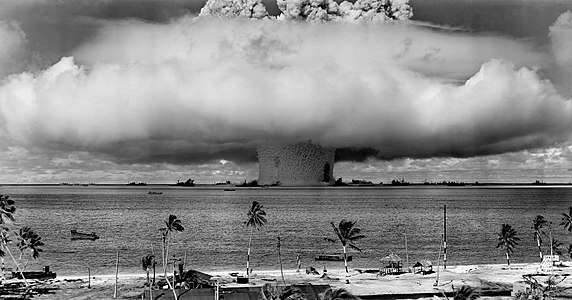
It's called the nuclear option for hyperbolic reasons.Phatscotty wrote:
It's called the nuclear option for a reason. Senate Democrats and the Obama administration have crossed the line, plain and simple.