From RANDOM.ORG
http://www.random.org/analysis/
Statistical Analysis
RANDOM.ORG is a true random number service that generates randomness via atmospheric noise. This page describes the two statistical analyses that have been conducted of the service.
Are the Numbers Really Random?
This question is surprisingly hard to answer. Before we try, let's define what exactly we mean by a random number.
When discussing single numbers, a random number is one that is drawn from a set of possible values, each of which is equally probable. In statistics, this is called a uniform distribution, because the distribution of probabilities for each number is uniform (i.e., the same) across the range of possible values. For example, a good (unloaded) die has the probability 1/6 of rolling a one, 1/6 of rolling a two and so on. Hence, the probability of each of the six numbers coming up is exactly the same, so we say any roll of our die has a uniform distribution. When discussing a sequence of random numbers, each number drawn must be statistically independent of the others. This means that drawing one value doesn't make that value less likely to occur again. This is exactly the case with our unloaded die: If you roll a six, that doesn't mean the chance of rolling another six changes.
So, why is it hard to test whether a given sequence of numbers is random? The reason is that if your random number generator (or your die) is good, each possible sequence of values (or die rolls) is equally likely to appear. This means that a good random number generators will also produce sequences that look nonrandom to the human eye (e.g., a series of ten rolls of six on our die) and which also fail any statistical tests that we might expose it to. If you flip enough coins, you will get sequences of coin flips that seen in isolation from the rest of the sequence don't look random at all. Scott Adams has drawn this as a Dilbert strip, which is funny exactly because it is true:
The problem with randomness: You can never be sure
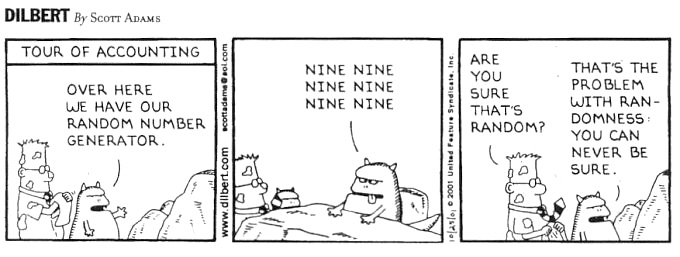
What Dilbert is told is correct: It is impossible to prove definitively whether a given sequence of numbers (and the generator that produced it) is random. It could happen that the creature in the comic strip has been generating perfectly random numbers for many years and that Dilbert simply happens to walk in at the moment when there's six nines in a row. It's not very likely, but if the creature sits there for long enough, it will eventually happen.
So, if it is impossible to definitively prove randomness, what can we do instead? The pragmatic approach is to take many sequences of random numbers from a given generator and subject them to a battery of statistical tests. As the sequences pass more of the tests, the confidence in the randomness of the numbers increases and so does the confidence in the generator. However, because we expect some sequences to appear nonrandom (like the ten rolls of six on our die), we should expect some of the sequences to fail at least some of the tests. However, if many sequences fail the tests, we should be suspicious. This is also way you would intuitively test a die to see if it is loaded: Roll it many times, and if you see too many sequences of the same value coming up, you should be suspicious.
If you look at the online statistics for RANDOM.ORG, you will sometimes see blocks of numbers that failed some of the tests. This does not mean that the numbers are not random. In fact, if all the blocks passed all the tests, we should be suspicious, because it would mean the generator would not be producing those sequences that don't look (but still would be) random.



 ).
).










 ! ) the attacker SHOULD kill more than he 'd loose !!!




 I always thought that the dice were pulled out of a hat!